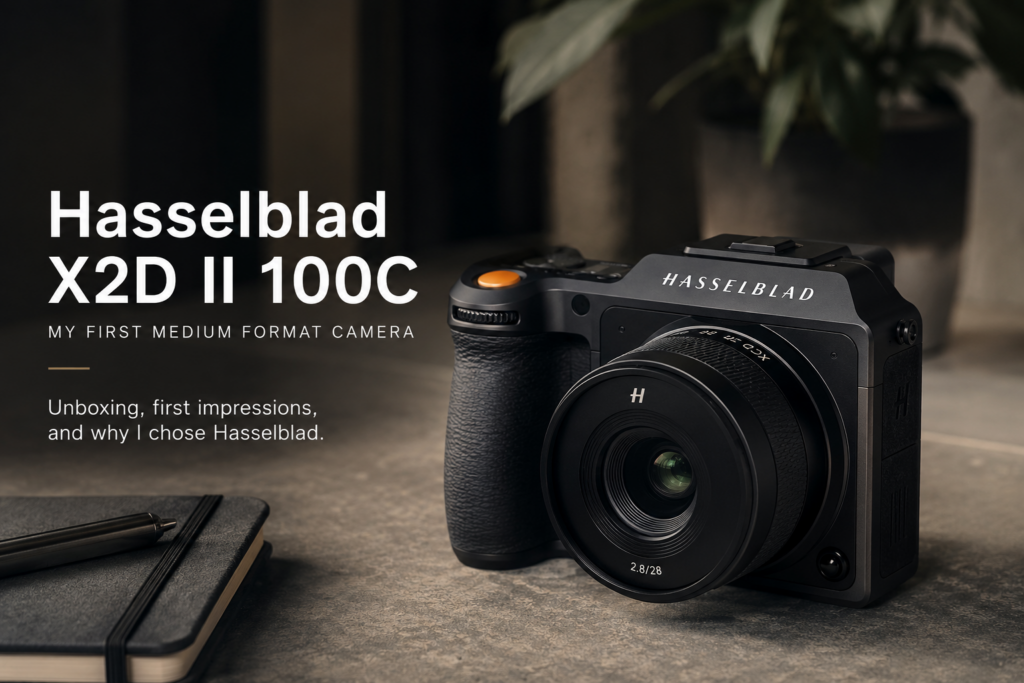
There’s something interesting about cameras. Some are designed to help you capture as much as possible, as quickly as possible. Faster autofocus. More frames per second. Better tracking. More features packed into menus and submenus.
And then there are cameras that seem designed to slow you down. That’s what attracted me to the Hasselblad X2D II 100C.
I’m not a professional photographer. I don’t shoot weddings. I’m not in a studio. Photography for me is personal — travel, landscapes, architecture, street scenes, and documenting moments and experiences while exploring new places.
Over the years I’ve used various Sony cameras, including early Alpha models, the Sony NEX system, and most recently the Sony RX10 IV. The RX10 IV was honestly an incredible travel camera for me because it could do almost everything reasonably well.
But after it was damaged recently, I unexpectedly found myself looking for something new. And somehow that search eventually led me here.
The Appeal of Hasselblad
For years, I’ve admired Hasselblad cameras from a distance.
Part of it was obviously the image quality and color science that photographers constantly talk about. But if I’m being honest, another big part was the design philosophy behind the cameras themselves.
I work in product, user experience, and design, so I naturally pay attention to how products feel — not just what they do.
The X2D II feels intentional.
Minimal without feeling empty.
Premium without feeling flashy.
Technical without feeling overwhelming.
It doesn’t feel like a gadget competing for attention. It feels like a creative tool. And in a world where so many devices constantly demand our attention, there’s something refreshing about that.
The Internal Debate Before Buying It
I spent a lot of time trying to convince myself not to buy this camera. Because objectively, it’s hard to justify.
- It’s expensive.
- It’s slower than many modern cameras.
- The files are massive.
- And medium format photography can sometimes feel almost romanticized online.
I kept asking myself:
- Is this practical?
- Will I actually carry it while traveling?
- Am I buying into hype?
- Is this overkill for someone who’s ultimately just an enthusiast?
Those questions didn’t really go away. But eventually I realized something important: I wasn’t looking for the most practical camera. I was looking for a camera that would make photography feel exciting again.
Slowing Down
One of the things that stood out to me almost immediately after picking up the X2D II was how much it encourages intentional photography.
You frame differently.
You pay attention differently.
You become more selective.
And honestly, I think there’s value in that. Especially now, when so much photography has become about speed, volume, and instant sharing.
Why the 28P Lens Made Sense
I paired the camera with the XCD 28P lens because portability mattered a lot to me. I travel frequently, and I didn’t want medium format to become something I only carried on special occasions. The 28P seemed like the best balance between image quality and portability for the kind of photography I enjoy most:
- travel,
- architecture,
- city scenes,
- landscapes,
- and environmental storytelling.
I wanted a setup that I would genuinely take with me. Not something that stayed at home because it was too large or inconvenient.
Watch the Unboxing Video
I also filmed the full unboxing and first impressions here: