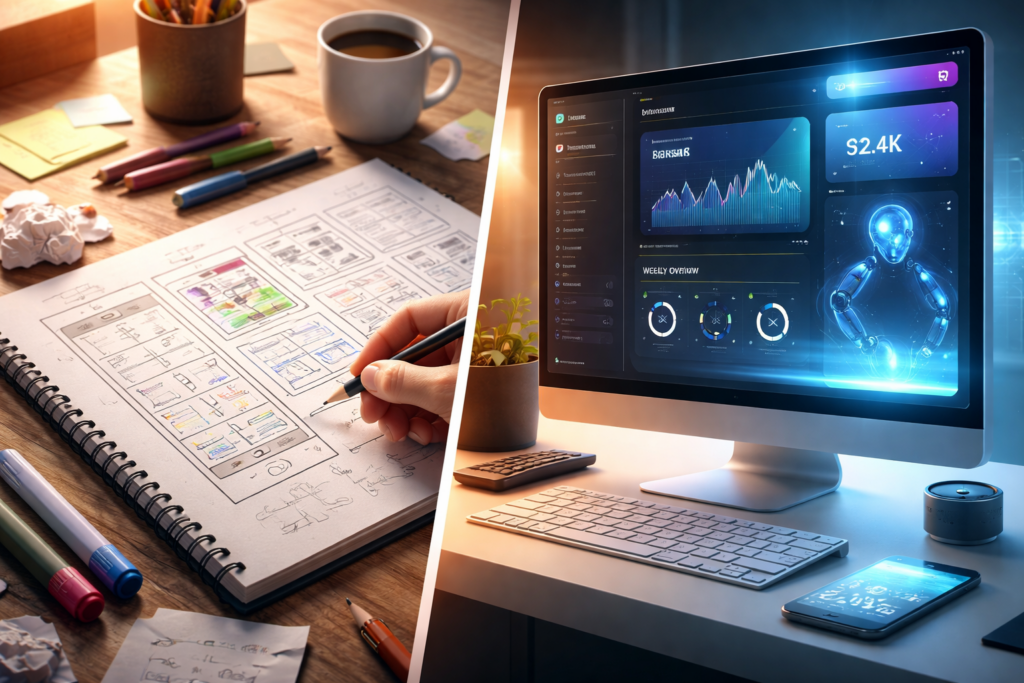
Over the past year, I’ve seen the same question come up again and again in conversations about AI and technology: “What jobs are safe?”
Developers worry about AI-generated code.
Writers worry about generative text.
Analysts worry about automated insights.
But there’s one discipline that may actually become more important, not less. Design.
Recently I read an article titled that made a bold claim: “as AI automates repetitive work across industries, designers—particularly those who can think creatively and holistically—may become some of the most valuable people in technology.”
At first, that sounds counterintuitive. After all, AI can now generate landing pages, dashboards, and entire interfaces with a prompt. But the deeper you look, the clearer something becomes:
AI can assemble things. Designers create experiences.
AI Is Great at Assembly. Not Judgment.
Today’s generative tools are incredibly good at producing layouts, UI components, and visual patterns. You can ask AI to generate a dashboard or landing page and get something functional almost instantly. But most of those outputs share a problem: they look… the same.
The article calls this phenomenon an “ocean of sameness.” When design systems, templates, and AI tools reuse the same patterns over and over, products start to blur together. You’ve probably noticed this already:
- Every SaaS dashboard looks similar
- Every AI product uses the same gradient aesthetics
- Every landing page follows the same hero-grid-testimonial pattern
AI can recombine existing patterns very well. What it struggles with is taste, judgment, and originality. That’s where human designers come in.
The Real Skill Is the Designer’s Eye
A powerful idea in the article is that the most important skill isn’t knowing tools—it’s developing a “designer’s eye.” Tools change constantly. Photoshop → Sketch → Figma → AI-assisted tools. But the underlying skill of design is something deeper:
- Seeing hierarchy and visual balance
- Understanding emotional responses to interfaces
- Recognizing when something feels wrong even if it technically works
- Knowing how to make an experience memorable
AI can generate components. But it doesn’t understand why something resonates with people. And in product design, that difference matters.
Design Is Both Structure and Art
For years, product design has leaned heavily toward systems:
- design systems
- component libraries
- tokens
- standardized patterns
Those are incredibly valuable for building complex products efficiently. But they also created an environment where many products became overly standardized. Design turned into assembling boxes on a screen rather than shaping an experience. AI will likely automate a lot of this assembly work.
Ironically, that may free designers to focus on the more interesting part: creativity.
The Next Era of Design: Experiences
If AI handles the repetitive 90%—layouts, components, documentation—designers can focus on the parts that actually differentiate products. Things like:
- interaction design
- storytelling
- emotional connection
- personality and brand identity
The article gives a great example: a product where a small interactive detail—a playful animation tied to how users move their phone—became one of the most beloved features. That kind of detail doesn’t emerge from a template. It comes from curiosity and experimentation.
Why This Matters for Product Teams
From a product leadership perspective, this shift is fascinating. For years the industry has emphasized:
- speed
- scale
- repeatability
- systems
Those things matter. But they also produced a lot of products that are technically solid yet emotionally forgettable.
In an AI-saturated world where anyone can generate a functional interface, differentiation will come from something else. Likely:
- thoughtful design
- distinctive interactions
- human storytelling
- real personality
In other words, experience design becomes the competitive advantage.
AI Won’t Replace Designers — It Will Filter Them
AI won’t eliminate design. But it will likely separate two types of practitioners:
- Assemblers People who mainly arrange components and follow patterns.
- Design thinkers People who understand users, storytelling, interaction, and emotional connection.
AI will handle a lot of the first category. The second category may become more valuable than ever.
The Human Element Is Returning
One of the most interesting observations in the article is that users increasingly crave human presence in digital experiences.
In a world flooded with generated content and templated interfaces, authenticity stands out.
Real photography.
Real stories.
Real personalities.
Design that feels human. That’s hard to automate.
My Take
As someone working in product, UX, and accessibility, this perspective resonates with what I’m seeing firsthand. AI is accelerating production. But acceleration alone doesn’t produce great products. Great products still require:
- empathy
- taste
- creativity
- judgment
And those qualities are deeply human. If anything, AI may push us back toward the original spirit of design: not just building things that work—but building things people actually love using.