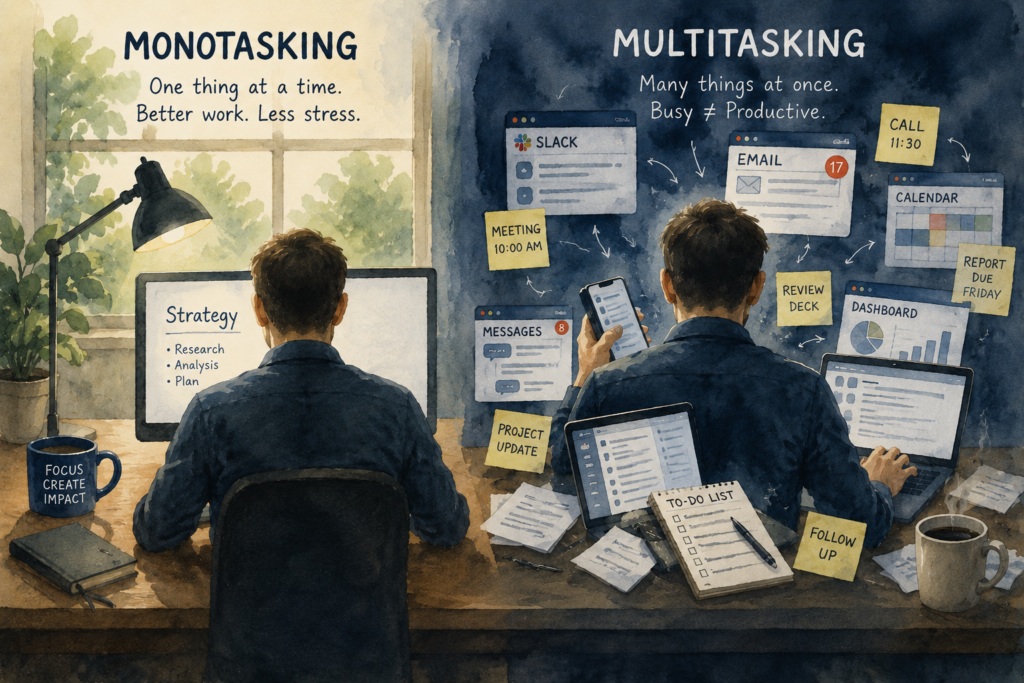
For years I’ve had a phrase I use whenever someone asks how I manage a busy workload:
“Multitasking is really just continuous partial attention.”
I didn’t invent the phrase, but it perfectly describes what I’ve observed throughout my career.
We often celebrate multitasking as a skill. Job descriptions ask for it. Managers praise employees who seem to juggle ten things at once. Entire workplace cultures are built around responsiveness, context switching, and being available every minute of the day.
The problem is that multitasking feels productive far more often than it actually is.
The Illusion of Progress
There is something satisfying about crossing twenty-five small items off a to-do list.
- Reply to an email.
- Join a quick meeting.
- Answer a Slack message.
- Review a document.
- Check a dashboard.
- Respond to another email.
At the end of the day, it feels like you’ve been moving nonstop. But did you actually accomplish anything meaningful?
Many of the most important tasks in our professional lives require uninterrupted thought. Strategic planning. Product design. Writing. Problem solving. Analysis. Learning something new. None of these activities benefit from being interrupted every few minutes.
In fact, they often suffer because of it. Each interruption forces your brain to reload context. The task may only take seconds to switch away from, but returning to it often takes much longer.
The result is a day filled with activity but surprisingly little progress.
What Monotasking Looks Like
Monotasking isn’t complicated. It simply means focusing on one meaningful thing at a time.
When I have a productive day, my to-do list doesn’t usually contain twenty-five items. More often, it contains two to five important outcomes.
- Finish a strategic roadmap.
- Create a product vision.
- Write a blog post.
- Analyze customer feedback.
- Prepare for an important presentation.
Those tasks might take hours rather than minutes. From the outside, it can even appear less productive. Someone glancing at my completed task list might wonder why only three items were finished.
What they don’t see is the depth of work behind those three items.
The Management Challenge
This is where monotasking becomes interesting. Not every manager views productivity the same way.
Some leaders value visible busyness. They measure performance by responsiveness, meeting attendance, or the number of tasks completed. Others focus on outcomes. The distinction matters.
A person practicing monotasking may not appear busy every minute of the day. They may spend long periods working quietly on a single problem. They may respond to messages less frequently. They may not produce a long list of completed micro-tasks.
Yet they may create significantly more value. The question leaders should ask isn’t: “How many things did this person do today?” It’s: “Did they move something important forward?” Those are very different measurements.
The Health Benefits We Don’t Talk About
There’s another side to this discussion. Constant context switching is exhausting.
Many people spend their workday bouncing between email, chat, meetings, notifications, phone calls, and project work. Their attention is fragmented from morning until evening.
That mental fragmentation creates stress. Monotasking creates space. It allows people to enter deeper states of concentration. It reduces the feeling that everything is urgent. It encourages intentional work rather than reactive work.
The result isn’t just better productivity. For many people, it’s a healthier and more sustainable way to work.
What This Means for Product and UX Design
As someone who works in product management and user experience, I see a parallel. Great software helps users focus. Poor software constantly interrupts them.
Every unnecessary notification, modal, popup, alert, and distraction competes for attention. Every context switch imposed by a system increases cognitive load.
The best products don’t demand more attention from users. They help users protect it.
That’s one reason why good UX often feels invisible. It removes friction. It simplifies decisions. It helps people stay focused on the task they’re trying to accomplish.
In many ways, good design is monotasking applied to software.
My Rule
Whenever I’m feeling overwhelmed, I ask a simple question:
“What are the two or three most important things I need to accomplish today?”
Not twenty-five things.
Not every email.
Not every notification.
Just the few things that will create the most value. The answer is rarely complicated. The hard part is protecting the time and attention required to actually do them.
And that’s why I’ve never been a believer in multitasking. Most of the time, it’s just continuous partial attention dressed up as productivity.